
Useful guide / outdoor audio
Portable speaker IP ratings explained
What IPX4, IPX7, IP67 and IP68 actually tell you, plus the practical checks to make before your speaker goes near water.
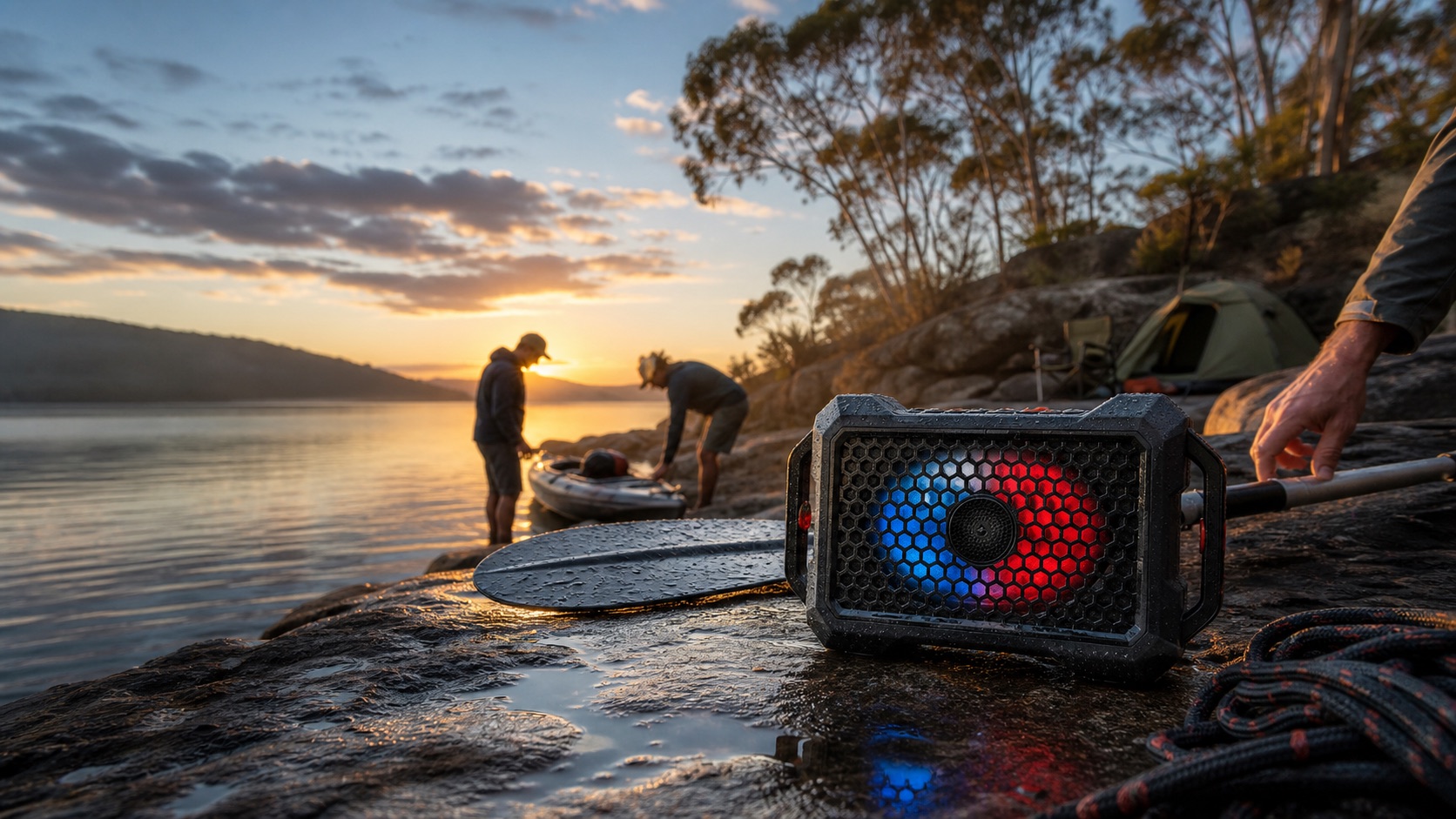
An IP rating tells you how an enclosure was tested against solid objects and water. It is useful evidence, but it is not a promise that every splash, swim or beach trip is safe.
The practical rule is simple: check the exact rating on the exact speaker, read the manufacturer’s limits, keep charging ports closed as directed and do not treat “water-resistant” as “indestructible”.
What the letters and numbers mean
IP stands for Ingress Protection. The system comes from IEC 60529, the international standard for classifying how an electrical enclosure protects against access, solid objects and harmful water ingress.
In a rating such as IP67, the first number relates to protection against access and solid foreign objects, including dust; the second relates to water ingress. An X means that a rating has not been specified for that position. It does not automatically mean zero protection.
That is why IPX7 and IP67 are not identical descriptions. Both specify a water rating of 7, but only IP67 also states the solid-particle rating.
The speaker ratings shoppers commonly see
| Rating | Plain-English interpretation | What it does not prove |
|---|---|---|
| IPX4 | Tested for splashing water under the applicable test conditions | Safe for immersion, high-pressure water or every wet environment |
| IPX5 / IPX6 | Tested against water jets at the relevant level | Safe to leave submerged or expose to chemicals, salt or pool water |
| IPX7 | Tested for temporary immersion under specified conditions | Unlimited depth, duration or repeated underwater use |
| IP67 | States both a high dust-protection level and temporary-immersion water level | That seals can never wear, or that every port position is safe |
| IP68 | Tested for immersion under conditions specified for the product | One universal depth or duration across every IP68 product |
The rating is only the start. The manufacturer’s product page or manual should state the test conditions, port-cover requirements, cleaning advice and exclusions for the model you are considering.
Choose for the situation, not the biggest number
Kitchen, bathroom bench or light rain
A clearly stated splash-resistance rating may be enough for incidental splashes, provided the manufacturer permits that use. Keep the speaker away from sinks, baths and shower spray, and never charge it while wet.
Backyard, campsite or day trip
Look at water protection, dust protection, battery life, carrying size and how exposed the controls and charging port will be. A speaker that is easy to move out of the weather can be more useful than a heavier model with a higher headline rating.
Pool or beach
Check the exact instructions before assuming a rating covers pool water, salt water, sand or deliberate immersion. Water resistance is tested under controlled conditions; real use adds impact, heat, sunscreen, salt, chemicals and ageing seals.
Boat, kayak or waterside use
A floating design, secure attachment point and manufacturer-approved exposure may matter as much as the IP number. “Marine” in a product name should not replace checking the verified rating and care instructions.
Five checks before you buy
- Find the exact IP rating. Do not rely on a generic “waterproof” badge.
- Read the model-specific test limits. Check depth, duration and permitted water exposure where stated.
- Check every cover and port. The rating may depend on a charging flap being fully closed.
- Match the whole product to the day. Battery life, size, controls, connections and attachment points still matter.
- Read the care instructions. Resistance can reduce with wear, and salt water, pool water, soap or sunscreen may need different handling.
Common mistakes
- assuming a higher number makes a speaker suitable for every wet situation;
- treating X as a tested dust rating;
- charging a wet speaker or leaving a port cover open;
- confusing temporary laboratory immersion with ongoing underwater use;
- ignoring salt, chlorine, soap, heat, impact and normal wear;
- copying the rating from a similar model instead of checking the exact product.
Ready to compare?
Find a speaker for the day you have planned.
Check the exact model details, availability and delivery before you buy.
Browse portable + outdoor speakersFrequently asked questions
Is IPX7 fully waterproof?
It means the product was tested for temporary immersion under defined conditions. It does not mean unlimited depth, time or exposure to every kind of liquid. Check the exact manufacturer instructions.
Is IP67 better than IPX7?
IP67 states both a solid-particle rating and a water rating. IPX7 states the water rating but does not specify a first-character rating. Which product is the better choice still depends on the intended use and the manufacturer’s limits.
Can I take an IP-rated speaker to the beach?
Only if the manufacturer permits the relevant exposure. Sand, salt water, heat and impact can create conditions that a simple headline rating does not fully describe.
Does water resistance last forever?
Do not assume it does. Resistance may diminish through wear, damage or ageing. Inspect seals and follow the care instructions.
Sources
- IEC 60529: Degrees of protection provided by enclosures
- NEMA technical bulletin on the two-character IP system
- Manufacturer handling example: water resistance and care
The manufacturer reference is a general handling example, not evidence for any speaker sold by Useful Bit. Product-specific claims must come from the exact speaker manufacturer record.